Yes, they are – and the gap between expectation and reality catches a significant number of learners out every year. Goodmayes driving test routes run through one of East London’s busiest and most complex driving environments. High traffic volumes, fast A-roads, multi-lane junctions, and constant pedestrian activity combine to create a test that demands much more than general driving confidence.
Please note: This article is preparation guidance only. The DVSA does not publish official driving test routes. The roads referenced here are based on instructor knowledge, learner feedback, and route pattern data – not confirmed DVSA examiner routes. Use this as a guide to inform your preparation, not as a definitive route map.
This guide is brought to you by Calm Pass Driving School, a Kettering-based driving school helping learners build real confidence before test day. Alongside professional driving lessons, we recommend tools like RouteBuddy Driving Test Routes to help learners familiarise themselves with the roads around their test centre before they sit their test.


Goodmayes Driving Test Centre: The Key Facts
Where Is the Goodmayes Driving Test Centre?
The Goodmayes driving test centre is located at 98 Goodmayes Road, Ilford, IG3 9UZ. It sits in the Goodmayes area of the London Borough of Redbridge, close to the A118 and within easy reach of several key road types that appear frequently around Goodmayes driving test routes. The centre is accessible by car and by public transport, with Goodmayes station nearby.
Book your test slot through the official DVSA booking page on GOV.UK.
What Is the Pass Rate at Goodmayes?
According to the DVSA’s official driving test statistics, the national average pass rate for the UK practical driving test sits at around 47 to 50 percent. Goodmayes historically performs below this national average, reflecting the complexity of its East London road network.
Pass rates shift year on year. Always check the DVSA’s statistics directly for the most current figures before drawing conclusions.
Why Is the Pass Rate Below Average?
The road network around Goodmayes is genuinely more demanding than most UK test centre environments. High traffic density, frequent pedestrian crossings, complex multi-lane junctions, and fast A-road sections all sit within a short distance of the test centre. Learners encounter more hazard opportunities per mile here than at most other centres in England.
What Do Goodmayes Driving Test Routes Actually Cover?
The Road Types Learners Encounter
Goodmayes driving test routes cover a demanding mix of East London road conditions. Learners can expect to come across:
- The A118 Eastern Avenue and surrounding A-roads with fast-moving traffic and frequent lane changes
- Goodmayes Road and the surrounding residential grid with parked vehicles and narrow sections
- Busy retail and commercial roads near Ilford town centre with high pedestrian activity
- The Seven Kings and Chadwell Heath areas with mixed residential and commercial traffic
- Multi-lane roundabouts and complex junctions on the outer roads
- Roads near Goodmayes Park and surrounding residential areas with school zones and pedestrian crossings
Furthermore, East London traffic volumes mean conditions change significantly throughout the day. Learners who practise only during quieter periods may find peak-hour test conditions much harder than expected.
How Does the A118 Affect Goodmayes Driving Test Routes?
The A118 Eastern Avenue is one of the most significant roads in the Goodmayes test area. It carries high volumes of fast-moving traffic and requires candidates to drive confidently at higher speeds, manage following distances correctly, and make assertive decisions when joining or leaving faster-moving traffic.
Moreover, the junctions off the A118 carry significant risk. Candidates who have not driven these specific junctions before can find the combination of speed and volume particularly unsettling under test pressure. As the Highway Code confirms, safe driving on faster roads requires early hazard anticipation and correct lane positioning throughout.
What Are the Most Common Faults on Goodmayes Driving Test Routes?
Based on the DVSA’s data on the most common driving test faults, the top fault categories across all test centres include junction observation, mirror use, and road positioning. Around Goodmayes driving test routes specifically, these areas create the most fault opportunities:
- Junction observation – emerging too early at busy A118 junctions and residential crossroads
- Mirror use – not checking adequately before lane changes on faster road sections
- Roundabout positioning – incorrect lane choice on multi-lane outer road roundabouts
- Pedestrian crossing responses – hesitating or misjudging near Ilford town centre and school zones
- Speed management – not adjusting speed promptly when moving between residential streets and A-road sections
Knowing these fault hotspots in advance gives learners a specific preparation target rather than a vague sense of needing to drive better.
How RouteBuddy Driving Test Routes Helps Learners Prepare
Practise the Roads That Actually Matter
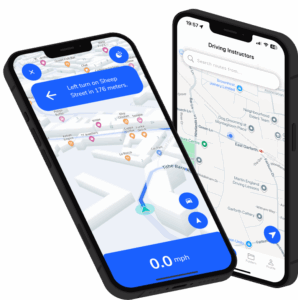
RouteBuddy Driving Test Routes is a driving test preparation app available on iOS and Android. It gives learners access to the roads most likely to come up in their test area, with turn-by-turn voice guidance that mirrors the independent driving section of the practical test.
For Goodmayes specifically, this means getting familiar with the A118 approach roads, the Goodmayes Road residential sections, the Ilford town centre junctions, and the multi-lane roundabouts on the outer roads before test day. By the time learners sit their test, those roads already feel familiar rather than frightening.
Sat-Nav Practice That Mirrors the Real Test
Since 2017, the independent driving section of the UK practical test has used a sat-nav for around 20 minutes. RouteBuddy Driving Test Routes mirrors this with turn-by-turn voice guidance so learners practise following directions on the roads that matter most. Following instructions on unfamiliar roads becomes second nature before the examiner’s car even moves.
Always Current
Every route in RouteBuddy Driving Test Routes is kept up to date with the latest road layouts, speed limits, and traffic conditions. What learners practise closely reflects what they are likely to face on test day at Goodmayes.
Available on iOS and Android
RouteBuddy Driving Test Routes is available on the Apple App Store and Google Play Store.
Practical Steps Before Your Goodmayes Test
Research and Book
- Check the latest Goodmayes pass rate at the DVSA’s official statistics page
- Book your test through the official DVSA booking page on GOV.UK
- Review the Highway Code for junctions, roundabouts, and faster roads
Prepare Specifically
- Download RouteBuddy Driving Test Routes and practise the roads around Goodmayes before test day
- Focus on the A118 junctions, Ilford town centre roads, and residential street positioning
- Ask your instructor to dedicate at least one lesson to the most demanding sections around the test centre
- Do a full mock test on the most common roads with no prompting and in full test conditions
- Practise at the same time of day as your actual test slot since East London traffic varies significantly throughout the day
On Test Day
- Arrive early at 98 Goodmayes Road, Ilford and give yourself time to settle
- Prepare all documents the night before so test morning is calm and unhurried
- Scan actively for speed limit signs and pedestrian crossings throughout the test
The Bottom Line
Goodmayes driving test routes are tougher than most learners think – and the pass rate data reflects that. The A118, the Ilford town centre junctions, and the East London traffic volumes create a test environment that exposes underprepared candidates quickly.
The learners who pass here are the ones who have driven these roads before. RouteBuddy Driving Test Routes gives every learner that advantage before they sit down in the examiner’s car.
RouteBuddy Driving Test Routes is available on the Apple App Store and Google Play Store.